 18+
18+
18+
18+
A ~97% RTP and high-volatility crash mechanic — here is exactly what those numbers mean for your bankroll in 2026.
Free demo — no real money. Mirrors the real game's behaviour. May be unavailable in some regions.
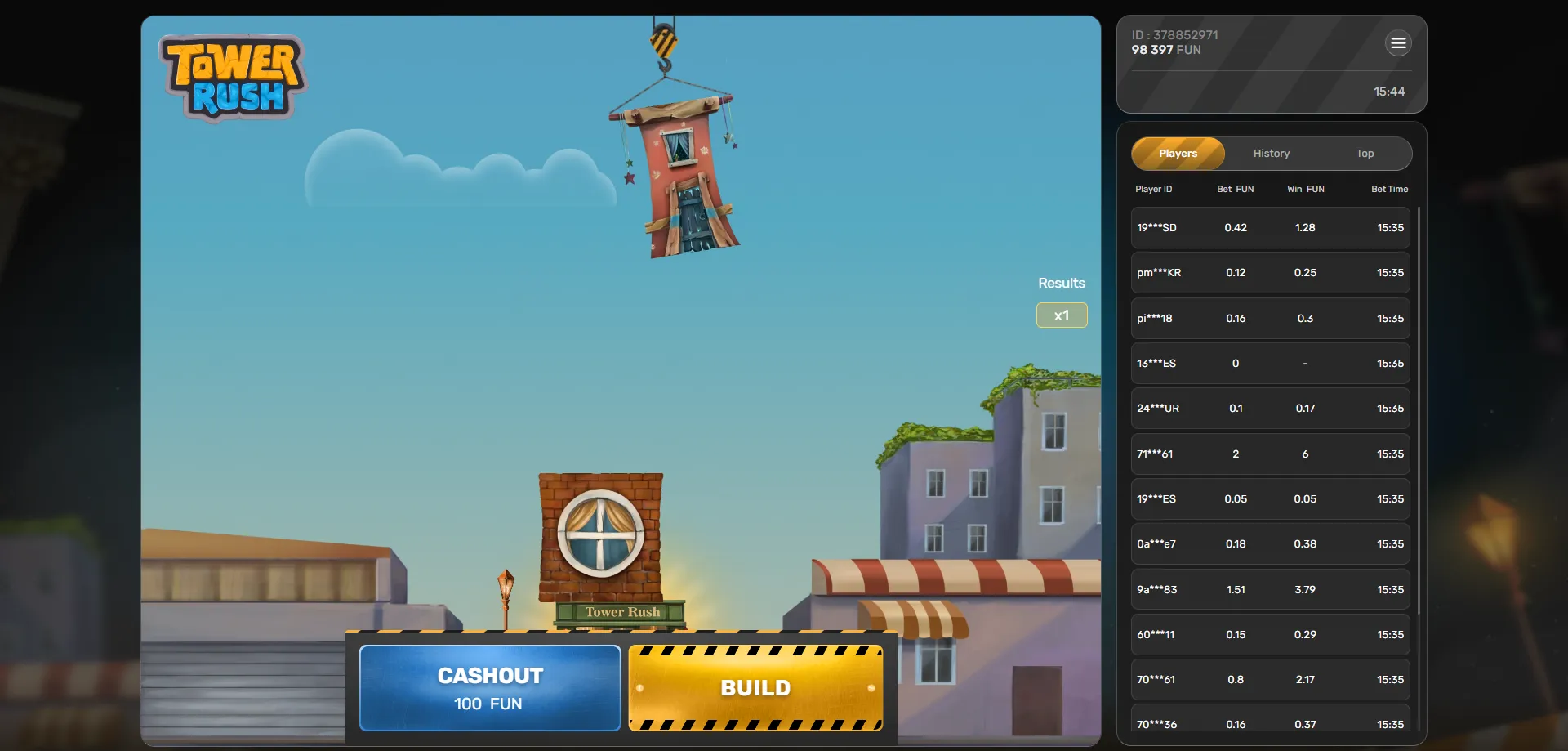
Tower Rush carries a published tower rush rtp of approximately 97%, issued through Galaxsys and independently verifiable via the game's provably fair system. That single figure is often the first — and only — stat a player checks before committing real money. The problem is that RTP alone tells you almost nothing about what a session will actually feel like. Two crash titles can share an identical 97% return rate yet deliver completely different experiences from the first round to the last.
The reason is volatility. RTP is a long-run average calculated across millions of rounds. Volatility describes how the game distributes those returns within any given session. A low-volatility title with 97% RTP tends to pay out small amounts frequently, keeping your balance relatively stable. Tower Rush, by contrast, is rated high volatility — the same 97% is clustered into less frequent but potentially much larger cash-out moments, with stretches in between where the tower collapses early and stakes are lost quickly.
In practical terms, high volatility means you must be prepared for your balance to swing sharply before it recovers. A session budget that would last an hour on a low-variance slot can be exhausted in minutes on Tower Rush if the tower collapses early across several consecutive rounds. Conversely, a single well-timed cash-out at a high multiplier can erase several rounds of losses in one event. This asymmetry is the defining feature of the high-volatility crash format, and understanding it before you open the game is not optional — it is the foundation of any sensible approach to bankroll management.
The most persistent myth is that a high RTP guarantees consistent winnings. It does not. A 97% RTP means that over tens of millions of rounds, the game theoretically returns ₹97 for every ₹100 wagered across all players combined. Your individual session of 50 or 100 rounds is a statistical sample so small that you could realistically see returns anywhere between 0% and 300% of your stake — and both outcomes would be entirely consistent with a 97% long-run figure.
The second myth is that RTP resets or "fills up" after a losing run. Each round in Tower Rush is an independent event. The provably fair system confirms that the crash point is determined before bets are placed and is unaffected by any prior round. There is no memory, no cycle, and no debt that the game owes you after a sequence of early collapses.
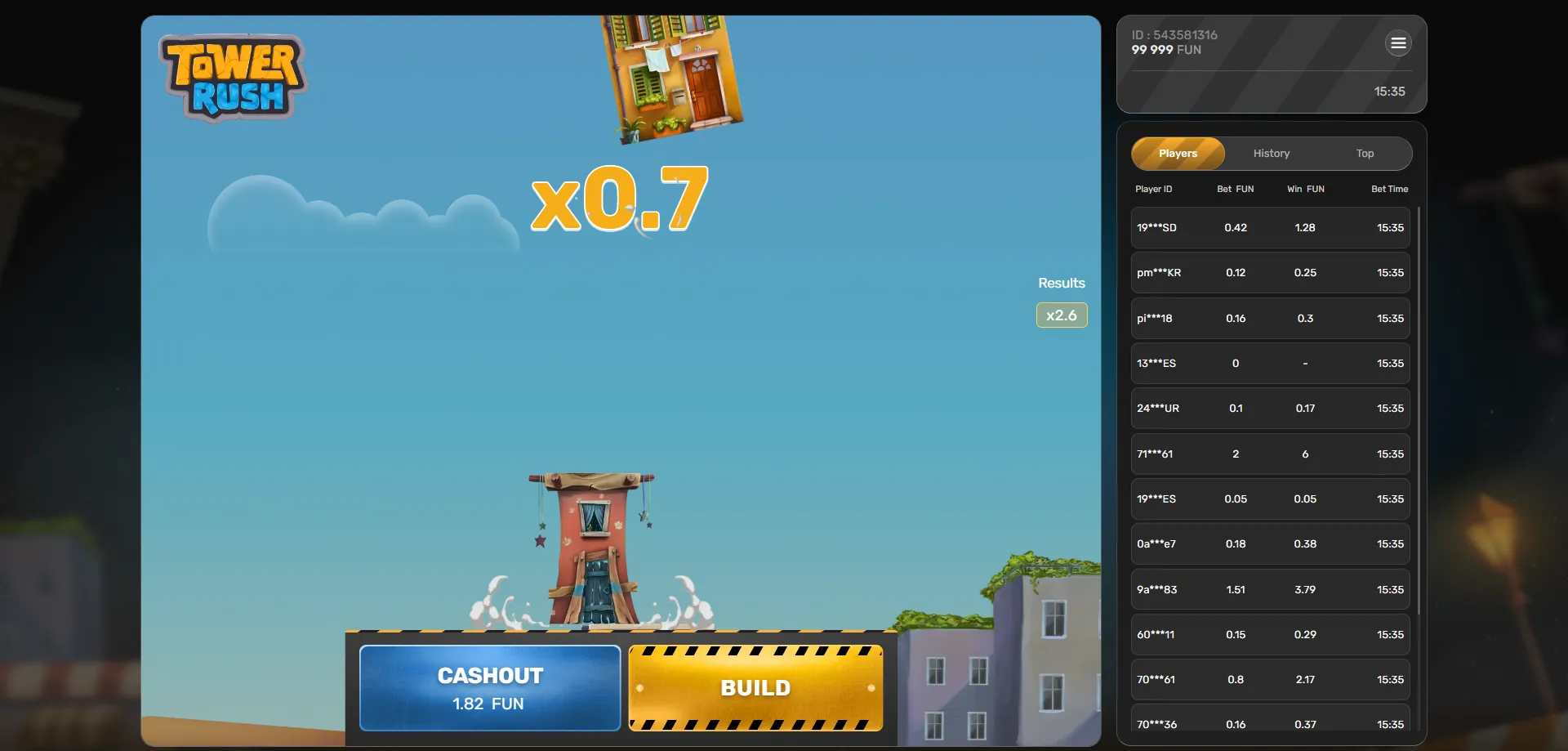
Relying on RTP in isolation is like reading only the headline of a contract. A complete picture of Tower Rush requires reading three figures side by side: the RTP, the volatility rating, and the hit rate. Together, these three values create what experienced players sometimes call the game's personality — a compact description of how it will behave across a real session rather than across a theoretical lifetime of play.
Hit rate — sometimes called win frequency — is the percentage of rounds in which a player receives a return on their stake. In Tower Rush, because every cash-out above 1× technically represents a positive return on that round, the hit rate is directly tied to cash-out strategy rather than a fixed paytable value. A player who consistently targets cash-outs at 1.5× will register a much higher personal hit rate than one targeting 10×, even though the underlying game mechanics are identical. This is a key distinction from traditional slots, where hit rate is a fixed property of the paytable. In Tower Rush, it is partially a variable that you control through timing discipline.
For high-volatility games like this one, the general principle holds: a lower hit rate is offset by larger individual returns when a round does pay. The game is not designed to reward you on most rounds; it is designed to reward patient, disciplined timing with significant multipliers on the rounds where you hold long enough.
Galaxsys publishes an RTP of approximately 97% for Tower Rush, though the exact figure can vary slightly depending on which operator is hosting the game. This is the theoretical RTP — calculated under laboratory conditions across an enormous sample of simulated rounds. Your actual RTP in any real session will differ, sometimes dramatically. The shorter your session, the wider the gap between what the theoretical RTP predicts and what you actually receive.
One practical implication: if your casino allows you to verify individual rounds through the provably fair seed system, do so. This does not change outcomes but it does confirm that each crash point was set by a certified RNG before your bet was placed — the clearest assurance currently available that the theoretical RTP is being generated honestly.
No single volatility level suits every player. The most useful thing a player can do before choosing their cash-out strategy on Tower Rush is to identify honestly which of three broad profiles describes their priorities for the session.
If your priority is entertainment over a defined period with minimal risk of rapid balance depletion, the appropriate strategy on Tower Rush is to target low multipliers consistently — typically in the 1.5× to 2× range. This mimics the behaviour of a low-volatility slot: smaller returns per round but a higher personal hit rate across the session. The 97% RTP is still in play, and because your individual bets are small relative to your session budget, variance has less opportunity to wipe out your bankroll before the statistical long run has time to work. This profile suits players who treat gambling primarily as leisure and want their session budget to last.
Players targeting multipliers of 5× or higher are operating at the extreme end of Tower Rush's risk spectrum. The potential payouts are substantial — the game has no fixed ceiling on multipliers, and Galaxsys has listed a 50× figure in promotional materials — but the frequency of success at these thresholds is low by design. You must be prepared to absorb consecutive early collapses before a round extends to your target multiplier. The practical requirement is a session budget large enough to survive a losing run without depleting your account, combined with the psychological discipline to stick to the auto cash-out setting rather than cashing out manually when a rising multiplier creates pressure to exit early.
The middle ground — targeting cash-outs in the 2× to 4× range — does not correspond to a different version of the game. Rather, it is a cash-out discipline that produces a session profile closer to medium volatility: wins are less frequent than at 1.5× but more frequent than at 10×, and each win is meaningful without requiring a rare high-multiplier event. Many experienced crash players favour this range because it provides enough return on winning rounds to justify the losses on collapsed rounds, without requiring the deep bankroll that consistent high-multiplier hunting demands.
Because Tower Rush is a single crash title rather than a catalogue of slots, this section addresses how the game's own configuration compares to the broader Galaxsys library and where Tower Rush sits relative to industry RTP benchmarks.
The casino industry average RTP for slots sits near 96%. Tower Rush's published figure of approximately 97% places it in the above-average category — a meaningful advantage for players who are comparing titles within the same casino lobby. If you are evaluating Tower Rush against other crash or instant-win titles at the same operator, an RTP approaching 97% is a genuine differentiator. For context, many branded or themed slots in a standard casino lobby carry RTPs between 94% and 96%, making Tower Rush's figure competitive without qualification.
Tower Rush does not advertise a fixed maximum multiplier cap in the way that a traditional slot lists a maximum win. The 50× figure referenced in Galaxsys promotional material represents one documented teaser threshold, but rounds can in principle extend well beyond this depending on how long the tower holds before collapsing. This open-ended multiplier structure is a characteristic of the crash format and is one of the reasons the game is classified as high volatility. Players drawn to high-volatility slot titles because of their large maximum win potential will find the crash format delivers a structurally similar payoff shape: infrequent wins, but with potentially substantial multipliers when they occur.
Bonuses at online casinos can meaningfully alter the effective RTP you experience during a session — sometimes in your favour, sometimes against it. The key variables are the wagering requirement and whether the bonus can be used on Tower Rush specifically. Many casinos that carry the Galaxsys catalogue impose wagering requirements of 30× to 50× on deposit bonuses, and some exclude crash games entirely from bonus wagering eligibility.
If Tower Rush is eligible for bonus wagering at your chosen operator, the mathematics work in your favour: you are effectively playing additional rounds funded by the casino, and the game's 97% RTP means the house edge on those bonus-funded rounds is lower than on most alternatives in the lobby. However, if the wagering requirement is high and the time limit is short, the high volatility of Tower Rush creates genuine risk — a losing streak during the bonus wagering period could deplete both the bonus and your deposit before the requirement is met.
Free spins, as a bonus type, do not directly apply to Tower Rush because the game has no spinning mechanic. Operators occasionally offer crash game credit bonuses or free-bet equivalents. These carry the same caveat: read the terms carefully before assuming the nominal bonus value translates into a proportional benefit to your session RTP.
Most casinos hosting the Galaxsys catalogue provide lobby filtering tools that allow you to sort or narrow games by provider, volatility rating, or RTP range. If you are approaching the lobby with a specific session budget and risk tolerance in mind, these filters are the fastest route to identifying compatible titles alongside Tower Rush.
When using RTP filters, set the lower bound at 96% to surface the above-average tier of the catalogue. Volatility filters allow you to isolate high-volatility crash and instant-win titles from low-volatility video slots, preventing a mismatch between your session strategy and the game you select. On mobile, these filters are typically accessible via a funnel or sort icon at the top of the game grid — available on both Android browsers and iOS Safari without requiring a dedicated app download.
If your casino's lobby does not offer granular RTP filtering, the Galaxsys developer page and independent game databases list the published RTP for each title in the catalogue. Cross-referencing these sources before depositing takes under two minutes and can prevent the frustration of discovering mid-session that a game carries a significantly lower RTP than you assumed.
Before diving deeper into the mechanics, it's worth exploring related guides on this site. The Tower Rush Strategy – Tips and Tricks to Win page covers specific cash-out approaches matched to different bankroll sizes. The Tower Rush Rules – How the Game Works page explains the crash mechanic in detail for first-time players. If you are still assessing whether the game is worth your time, the Tower Rush Review – Is It Legit? covers licensing, payout reliability, and player feedback in full.
Register at sasthakitchen.com today to unlock an exclusive welcome package. Start climbing towards massive multipliers with your instant bonus spins!
🚀 Play Tower Rush🔒 18+ · T&C Apply · Play Responsibly